Introduction to integrated methods in the vegetable garden
Nitrate measurement tools


Chapter : Fertilization
Previous or next articles ; click on a title to go to the page
⇒ Nitrate measurement tools.
Introduction to integrated methods in the vegetable garden
Chapter : Fertilization
Previous or next articles ; click on a title to go to the page
⇒ Nitrate measurement tools.
There are electronic nitrate testers available on some websites, but they are very expensive. Some farmers use Quantofix laboratory test strips available on websites which can be obtained by clicking here (about 100 strips which is more than enough for 2 years of use) or here.
Please note that these strips only measure the immediate availability of plant-available nitrates, and not the total reserve of long-term nitrogen contained in organic matter (not plant-available) and ammonium ions fixed in CAC. More precisely, these measurements only indicate the content of nitrate not taken up by plants at a given time. Nitrate levels can drop in the next few days if the long-term nitrogen supply is not sufficient, especially if certain plants are grown, such as salads, which consume a lot of nitrogen. Nitrate levels can also increase during cultivation or intercropping if the long-term nitrogen supply is too high, indicating a risk of losses to the water table at the first rainfall. In uncultivated soil without weeds (or intercropping cover), the nitrate content should be as low as possible. Nitrates are natural substances that are always present in the soil in varying amounts depending on location, weather and season.... It is therefore not necessary to try to reduce them completely by not using organic or mineral inputs under the pretext of protecting the environment.
The presence of nitrate in cultivated soils leads plants to absorb mainly this element. If there is a significant reduction of nitrate in the soil, it means that plants are forced to absorb ammonium ions from CAC, which may not have sufficient reserves in the short term. This is the time to act to avoid a nitrogen deficiency.
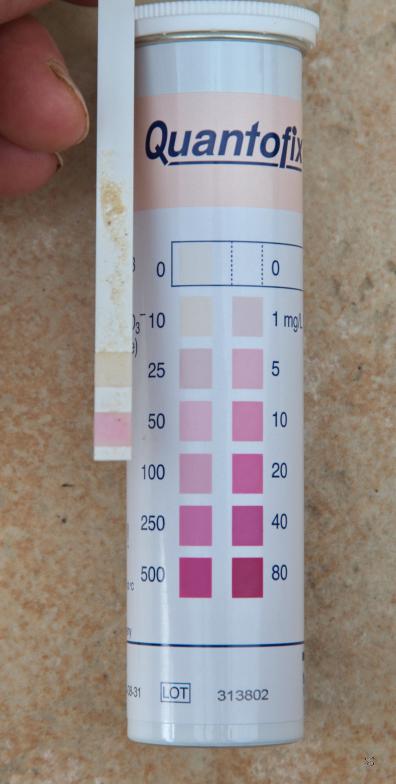
Measurement of a solution containing nitrates using a Quantofix strip (on the left)
To use the Quantofix strips, a solution should be prepared by mixing 100 g of garden soil with 200 ml of distilled water. It is not necessary to filter the solution. Never use tap water, which may contain nitrate ions, which would falsify the measurements. The Quantofix test strips can also be used to measure nitrite. The concentration of nitrate and nitrite is determined by comparison with a colorimetric scale. Generally speaking, for garden soil, a nitrate value of 25 to 50 mg/L is considered satisfactory for most vegetable plants.
The corrective volume of nitrogen is determined from these measurements. Each application should be followed a few days later by a new analysis in order to fine-tune the amount of nitrogen to be applied.
Note :
Nitrite is produced by the nitrification of ammonium and tends to bind to metals. Nitrite is converted to nitrate by the nitrobacter bacteria present in the soil.
For those who want to contact to a laboratory to find out what nitrates are left in a cultivated soil, it is important to observe the following rules:
Since warm, moist soils continue to accumulate nitrates through microbial activity, samples should be sent to a laboratory for analysis within 48 hours. Samples should be kept refrigerated before being sent for analysis. Samples should not be frozen, as the soil nitrogen may change form when thawed and an accurate result cannot be obtained. If samples cannot be sent to a laboratory within 48 hours, they should be air-dried before shipping.
In conventional agriculture, it is recommended to test for unused nitrate after the last harvest. Samples should be taken at a time and depth that allows for a more accurate determination of unused nitrate after the last growing season, usually before the autumn rain washes out the nitrate in the upper part of the crop soil (15-30 cm).


Specify a search word ⇒
The search will be conducted in all chapters and articles
